The Deerhound, also known as the Scottish Deerhound, is often described as an aristocrat among dogs. Its long-standing presence in Scotland is confirmed by early medieval and medieval descriptions of these noble sighthounds, making it one of the oldest Scottish dog breeds. Sir Walter Scott, the famous Scottish poet, immortalised the breed in many of his poems in the 18th century, while Edwin Landseer depicted Deerhounds in his paintings in the 19th century.
Whether the Deerhound is an ancient breed, a direct descendant of the wolf, or rather the result of Celtic sighthounds crossed with other large breeds cannot be stated with certainty. It may theoretically be a relic of an ancient dog breed that was widespread throughout Britain and much of Western Europe even before the arrival of the Celts. Roman descriptions of Celtic sighthounds from the 3rd century may already refer to the Deerhound.
With its rough, weather-resistant coat (most commonly silver-grey, blue-grey, or dark grey) the Deerhound is perfectly adapted to the harsh climate of the British Highlands and well suited to outdoor activity. Its appearance inevitably evokes images of Scottish castles and the vast estates surrounding majestic country homes. Historically, Deerhounds were indeed kept in such surroundings and used by their predominantly aristocratic owners for hunting deer, elk, and roe deer.
Gradually, in the 18th century, Deerhounds ceased to be used for hunting, having been replaced by firearms. And although, like many breeds, the Scottish Deerhound lost its original purpose, it did not lose the noble and captivating qualities that make it a wonderful companion dog.
FCI BREED STANDARDGeneral Appearance
Resembles a rough-coated Greyhound of larger size and stronger bone. The build suggests a unique combination of speed, strength, and stamina required to bring down a deer, while the overall impression is one of gentle dignity.
Head and Skull
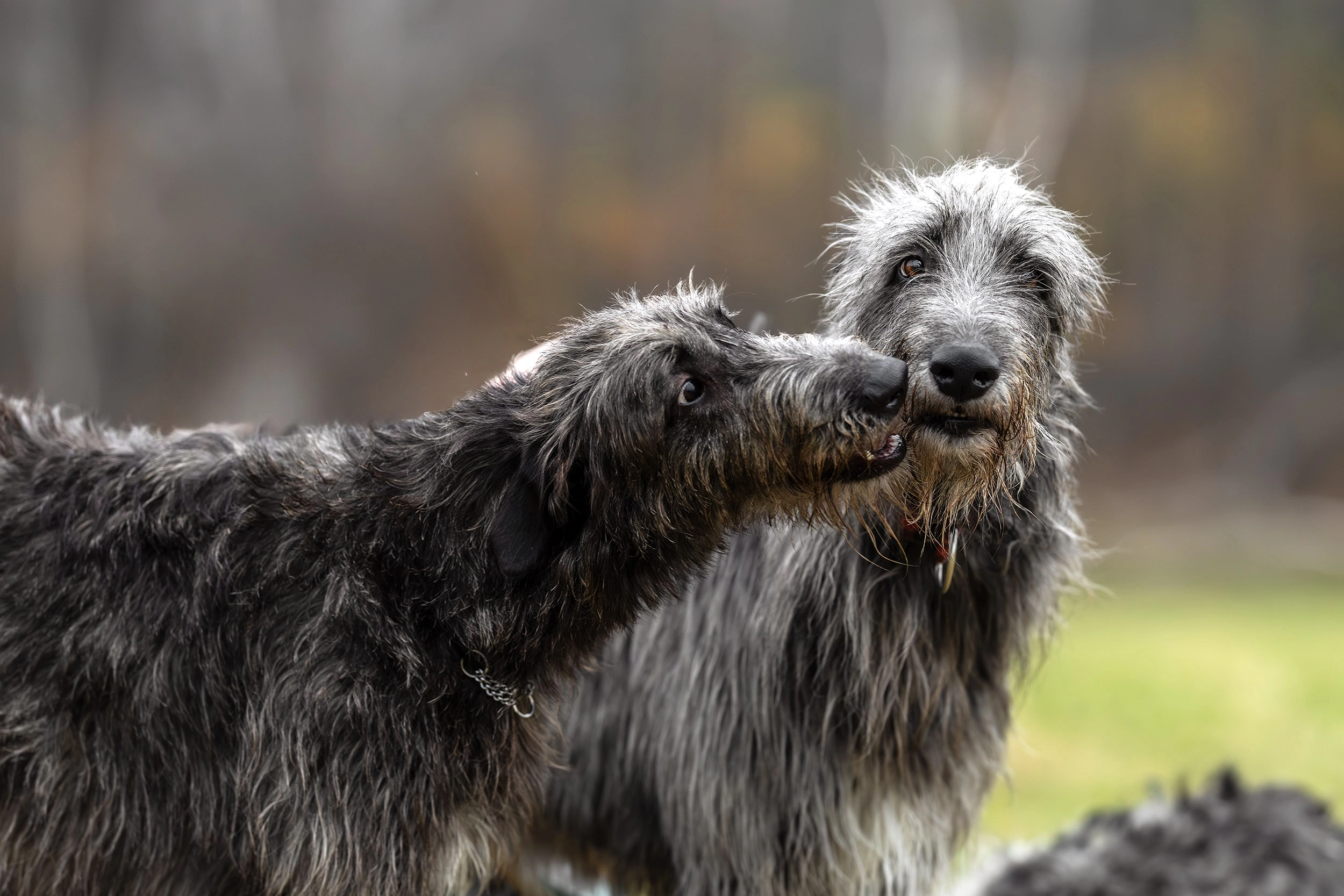
Broadest at the ears, tapering slightly towards the eyes, with the muzzle tapering more distinctly towards the nose; lips level. The head is long, the skull rather flat than round, with very slight rise over the eyes and no stop. The skull is covered with moderately long hair, softer than the rest of the coat. The nose is slightly aquiline and black; in lighter-coloured dogs, a black muzzle is preferred. Distinct whiskers of rather silky hair and a slight beard.
Temperament
Gentle and friendly by nature, the Deerhound enjoys pleasing its owner and being close to them. Quiet and mild-mannered, it is never suspicious, aggressive, or nervous. It moves lightly and with dignity.
Eyes
Dark, usually dark brown or hazel. Light eyes are undesirable. Moderately full, with a gentle expression at rest, but keen and far-seeing when the dog is alert. Black rims around the eyes.
Ears
Set on high and folded back when at rest. When excited, raised above the head without losing the fold, and in some cases semi-erect. Black or dark, soft, glossy, and mouse-like in texture; the smaller, the better, with no long hair or fringes. Large, thick ears lying flat against the head or standing upright are undesirable.
Muzzle
Strong jaws with a perfect, regular, and complete scissor bite, meaning the upper incisors closely overlap the lower incisors and are set square to the jaws.
Neck
Very strong, with good reach, sometimes masked by a mane. The nape is very prominent at the junction with the head; no dewlap.
Forequarters
Shoulders well laid back and not too widely spaced. Loaded or straight shoulders are undesirable. Forelegs straight, wide, and flat, with broad forearms and elbows desirable.
Body
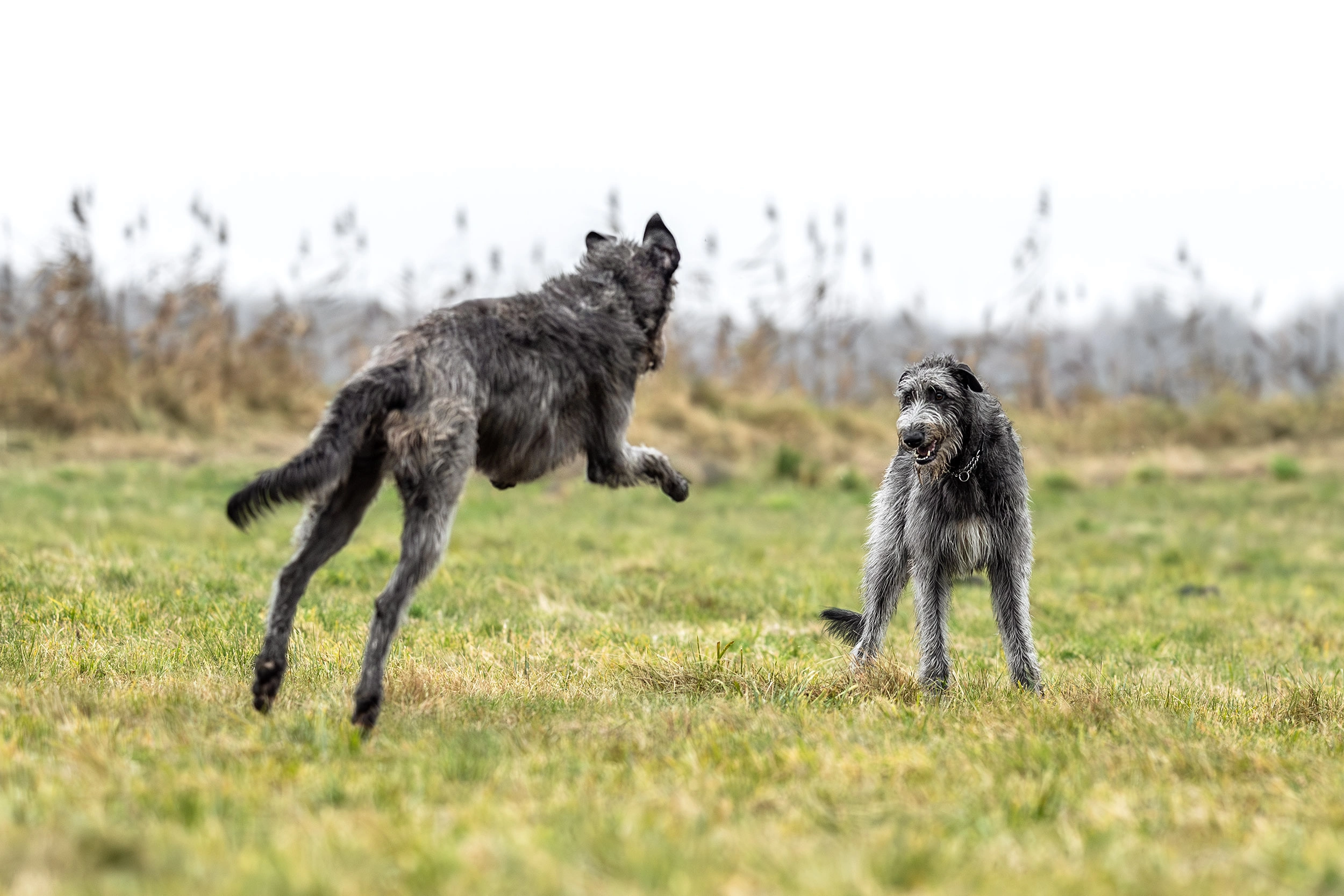
Built like a larger, more strongly boned Greyhound. Chest deeper rather than wide, not too narrow, with flat sides. Loin well arched and falling away towards the tail. A flat back is undesirable.
Hindquarters
Drooping, broad, and powerful hips, set wide apart. Hind legs well angulated at the stifle, with great length from hip to hock. Bone wide and flat.
Feet
Compact and well knuckled, with strong nails.
Tail
Long, thick at the base, tapering towards the end and reaching almost to the ground. At rest, carried perfectly straight down or slightly curved. In motion, carried raised but never above the level of the back. Well covered with hair; thick and rough on the upper side, longer underneath, with a slight fringe at the tip permissible. A tail ending in a ring curl is undesirable.
Movement
Easy, active, and true, with long stride.
Coat
Shaggy but not excessive. Woolly hair is highly undesirable. The correct coat is thick, close-lying, ragged; harsh or wiry to the touch. Hair on the body, neck, and hindquarters harsh and wiry, about 8–10 cm long; much softer on the head, chest, and belly. Slight hairy fringes on the inner sides of the forelegs and hind legs.
Colour
Dark blue-grey, darker and lighter shades of grey, brindle, yellow, sandy-red, or red-fawn with black points. A white chest, white toes, and a slight white tip to the tail are permissible, but the less white the better, as this is a self-coloured dog. A white blaze on the head or a white collar is not permissible. Any other colours or colour combinations are not allowed.
SIZE
Height:
Dogs: minimum desirable height 76 cm
Bitches: 71 cm
Weight:
Dogs: from 45.5 kg
Bitches: from 36.5 kg
For people who treat a dog as a companion, understand the independent nature of a sighthound, and do not expect blind obedience. The Deerhound is very people-oriented and enjoys pleasing its owner, but it also has a sensitive temperament. A fellow sighthound breeder once told me: “You don’t command a sighthound, you ask.” Therefore, if you plan intensive obedience training, you should choose a different breed.
A successful partnership with a Deerhound is best suited to those who enjoy spending time in nature. The Deerhound loves free movement during walks, where it can decide for itself whether it prefers calm exploration or a short sprint. Before choosing a Scottish Deerhound, consider whether you can provide daily off-leash walks in a safe, open area. Do not assume that jogging with a Deerhound attached to a running belt or bicycle will meet its needs. Long, monotonous running bores the breed, and you will not be able to match your pace to its true capabilities.
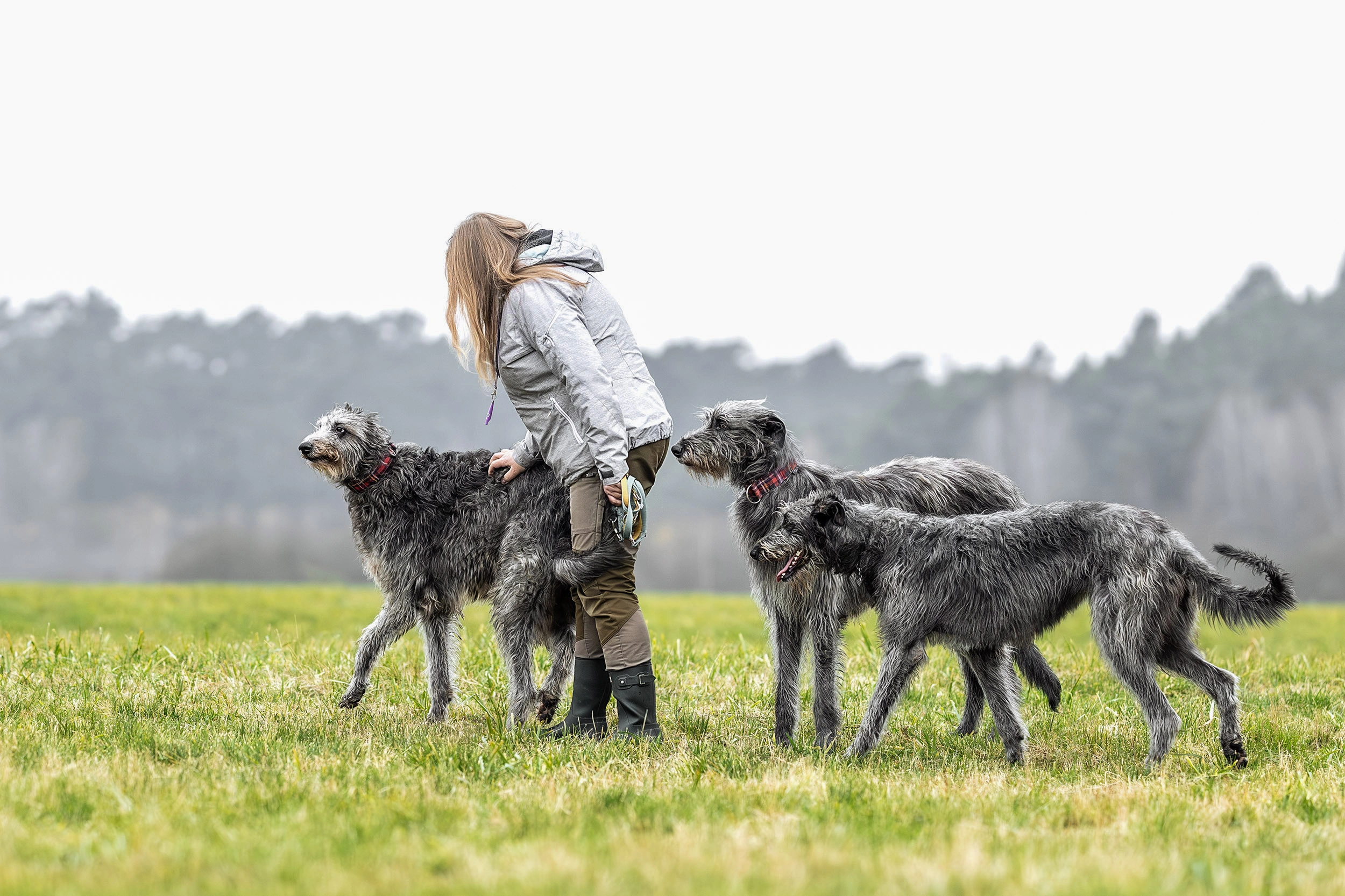
Although the Deerhound’s appearance may command respect, do not expect it to be a good guard dog. It values peace and quiet and will not alert you by barking when strangers enter your home. On the contrary, it is likely to greet them in a friendly manner or remain neutral. If you are looking for a guarding or protection dog, the Deerhound will disappoint you.
And what about families with children? In that case, consider whether you can provide the dog with a calm, safe space that your children will respect. Deerhounds spend most of their time at home sleeping, and it is important that their rest is not disturbed. Also keep in mind that a dog of such large size may accidentally knock over a child. And finally, remember: a Deerhound is not a pony! Do not allow children to sit on or try to ride the dog, as this could cause serious injury.
If you would like to learn more about everyday life with a Deerhound, we invite you to read our blog article:
Life with a Deerhound